General Overview
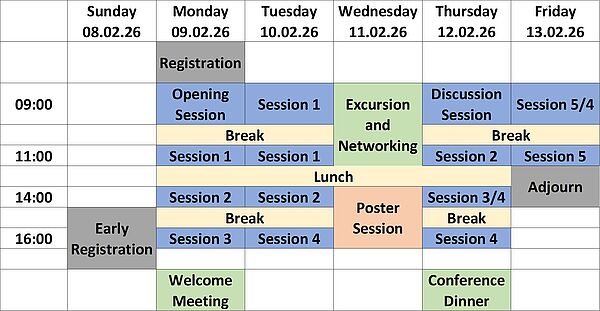
Scientific Programme and Abstracts
Download the Scientific Programme and Book of Abstracts here:
Quick Links:
Opening Session
Monday, 09.02.2026
09:00 - 10:30
| 09:00 - 09:30 | Claudia Stolle (Chair of ISEA-17 Scientific Organizing Committee) José Moncada-Jiménez (Vice Rector for Research of the University of Costa Rica) Marcial Garbanzo (Chair of ISEA-17 Local Organizing Committee) |
| 09:30 - 10:00 | John Meriwether | Upper atmosphere dynamics in the low latitude region studied by optical means: a review |
| 10:00 - 10:30 | Robert F. Pfaff | Exploring the Earth’s Atmospheric Dynamo and Electrojet Current Systems with Sounding Rockets |
Oral Scientific Sessions
Monday, 09.02.2026
11:00 - 12:20 Session 1: Global- and large-scale variability of low-latitude aeronomy
Chair: Nick Pedatella
| 11:00 - 11:20 | Claire Gasque | Investigating the Variability and Ionospheric Impacts of Equatorial Thermospheric Solar Terminator Waves (invited) |
| 11:20 - 11:35 | Chandan Kapil | Unusual Super Plasma Bubble Formation During Weak Geomagnetic Activity Over Europe: Evidence and Causes |
| 11:35 - 11:50 | Christine Amory | Ionospheric and magnetic signatures of Space Weather events at low latitudes |
| 11:50 - 12:05 | Samuel Ogunjo (presented by Babatunde Rabiu) | On the dynamical processes governing the day-to-day variability in maximum TEC values at an equatorial station |
| 12:05 - 12:20 | Dai Koshin | Influence of the Stratospheric Quasi-Biennial Oscillation on the Seasonal Variation of the Mesosphere and Lower Thermosphere Based on a Long-term Reanalysis JAWARA |
14:00 - 15:20 Session 2: Equatorial E- and F-region irregularities: Causes and Effects
Chair: Astrid Maute
| 14:00 - 14:20 | Meers Oppenheim | What's New in Understanding Electrojet Turbulence? (invited) |
| 14:20 - 14:35 | Lalitha G Krishnan | Long-Duration Equatorial Blanketing ES Layers and Their Implications on the Vertical Distribution of E-Region Plasma Irregularities |
| 14:35 - 14:50 | Jonas Sousasantos | Unraveling Subtle Connections Between Geomagnetic Activity and Equatorial Plasma Bubble Generation Across Seasons |
| 14:50 - 15:05 | Cesar Valladares | Near 1 Kilometer Irregularities: their origin and role in Space Weather |
| 15:05 - 15:20 | Suman Das | Identifying Precursors of Equatorial Plasma Bubbles using TEC measurements from C/NOFS-CERTO in Southeast Asia |
16:00 - 17:55 Session 3: Atmosphere-ionosphere-magnetosphere coupling at low-latitudes
Chair: Duggirala Pallamraju
| 16:00 - 16:20 | Geeta Vichare | Overview of the solar wind-magnetosphere-ionosphere-atmosphere coupling effects at low latitudes (invited) |
| 16:20 - 16:35 | Yongliang Zhang | Mid and low latitude thermospheric response to geomagnetic storms and solar flares |
| 16:35 - 16:50 | Federico Gasperini | Exploring The Response of The Magnetosphere to Terrestrial Weather using MAGE/TIEGCM |
| 16:50 - 17:05 | Jianhui HE | Improved NO Cooling Rate in a Coupled Thermosphere-Ionosphere Model During Solar Eclipse and Geomagnetic Storm Period |
| 17:05 - 17:20 | Robert Pfaff | Sporadic-E Layer Electrodynamics Revealed from Combined Sounding Rocket and VHF Radar Observations |
| 17:20 - 17:35 | Angeline Burrell | Topside Ionospheric Response to Large-Scale Traveling Ionospheric Disturbances |
| 17:35 - 17:55 | Nicholas Pedatella | Impacts of Stratosphere Polar Vortex Variability on the Equatorial Ionosphere (invited) |
18:00 - 20:00 Welcome Meeting
Tuesday, 10.02.2026
9:00 - 10:35 Session 1: Global- and large-scale variability of low-latitude aeronomy
Chair: Christine Amory
| 9:00 - 9:20 | Astrid Maute | Challenges and Opportunities in Characterizing Low-Latitude Ionospheric Variability: Insights from the Migrating Terdiurnal Tide (invited) |
| 9:20 - 9:35 | Roberto Flores | Tidal analysis of ExB vertical drifts based on measurements with the new JULIA-MP mode at Jicamarca |
| 9:35 - 9:50 | Babatunde Rabiu | Machine learning prediction of daily maximum and minimum vTEC values at an African Equatorial Station |
| 9:50 - 10:05 | Pallam Raju Duggirala | On the global consequences in the upper atmospheric phenomena during the two severe geomagnetic storms of May and October 2024 |
| 10:05 - 10:20 | Manu T | Night-time Equatorial Airglow Response to the Geomagnetic Storm of January 2025: Observations from Indian region |
| 10:20 - 10:35 | Sunil Kumar | Migrating Semidiurnal Solar Tide Response to Arctic and Antarctic SPV Strength Variability |
11:00 - 12:00 Session 1: Global- and large-scale variability of low-latitude aeronomy
Chair: Babatunde Rabiu
| 11:00 - 11:15 | Sovit Khadka | Global-Scale Wave Dynamics and Their Effects on the Interhemispheric Asymmetry of the Equatorial Ionization Anomaly |
| 11:15 - 11:30 | Ludger Scherliess | The Atmospheric Waves Experiment (AWE) |
| 11:30 - 11:45 | Cesar Valladares | Total Electron Content Enhancements (TEC) near the boundary between the low and mid latitudes in the American Sector |
| 11:45 - 12:00 | Robert Pfaff | E x B Plasma Drifts and Ionospheric Currents Observed at Low Latitudes by Instruments on the C/NOFS Satellite |
14:00 - 15:30 Session 2: Equatorial E- and F-region irregularities: Causes and Effects
Chair: Irina Zakharenkova
| 14:00 - 14:15 | Yvelice Soraya Castillo Rosales | On the first results of scintillation observations in Tegucigalpa, Honduras enabled by a ScintPi monitor |
| 14:15 - 14:30 | David Knudsen | Evidence for Field-Aligned Structuring of Equatorial Plasma Bubbles |
| 14:30 - 14:45 | Komal Madan (presented by Pallam Raju Duggirala) | First results on the altitudinal behaviour of the E- and F-regions using the emissions from twin peaks of green line dayglow |
| 14:45 - 15:00 | Vishnupriya KS | Multi-instrument study on the generation, evolution, morphology and energy cascading of night-time equatorial F- region irregularities during geomagnetically quiet and disturbed periods |
| 15:00 - 15:15 | Thomas Immel | Effects of geomagnetic activity on equatorial plasma bubble occurrence. |
| 15:15 - 15:30 | Dustin Hickey | Ionospheric Model Validation of Equatorial Ionization Anomaly Crests |
16:00 - 17:20 Session 4: Recent advances in instrumentation and observation
Chair: Danny Scipion
| 16:00 - 16:20 | Dave Fritts | Equatorial MLT Dynamics Revealed by the NASA Atmospheric Waves Experiment (AWE) (invited) |
| 16:20 - 16:35 | Jorge L. Chau | Multi-Scale Observations of neutral winds and E-region irregularities in the Lower Thermosphere with SIMONe systems at low latitudes |
| 16:35 - 16:50 | Aderonke Akerele | On the Characterisation of the Ionosphere using a Low-Cost SDR-Based Ionosonde within African Equatorial Region |
| 16:50 - 17:05 | John Meriwether | A new 20 cm aperture Fabry-Perot interferometer designed to measure Doppler shifts and Doppler broadening for both O 630 nm and He 1083 nm spectral profiles |
| 17:05 - 17:20 | Juergen Matzka | Recent developments at equatorial magnetometer stations with GFZ contributions |
Thursday, 12.02.2026
09:00 - 10:30 Discussion Session: Space traffic and sustainability
| Panelists |
Ian Christensen (Secure World Foundation) Anja Strømme (ESA, EU) Mike Nicolls (Space-X, USA) Gerd Baumgarten (IAP, Germany) Juha Vierinen (University of Tromsø, Norway) Xinan Yue (IGG at CAS, China) |
10:30 Group Photo
11:00 - 12:35 Session 2: Equatorial E- and F-region irregularities: Causes and Effects
Chair: Suman Kumar Das
| 11:00 - 11:20 | Irina Zakharenkova | Ionospheric super plasma bubbles occurrence during strong geomagnetic storms (invited) |
| 11:20 - 11:35 | Claudia Stolle | Modelling and prediction of night-time equatorial F region plasma irregularities based on geomagnetic and electron density data of the Swarm satellite mission |
| 11:35 - 11:50 | David Hysell | Forecast simulations of ionospheric interchange instability leading to equatorial spread F (ESF) |
| 11:50 - 12:05 | Paul Bernhardt | Detection and Tracking of Low Altitude Space Debris that Pass Through Equatorial Irregularity Plumes |
| 12:05 - 12:20 | Susan Palacios | Climatology study of equatorial spread-F morphology across Solar Cycles 23&25 (1999&2022) using U-Net |
| 12:20 - 12:35 | Fabiano Rodrigues | ScintPi studies of ionospheric irregularities and scintillation at low and mid latitudes |
14:00 - 15:40 Session 3: Atmosphere-ionosphere-magnetosphere coupling at low-latitudes: Causes and Effects &
Session 4: Recent advances in instrumentation and observation
Chair: Angeline Burell
| 14:00 - 14:15 | Shasha Zou | Unraveling Super Equatorial Plasma Bubbles (EPBs) Development During the April 23, 2023 Storm: Multi-instrument Observations and GITM-SAMI3 Simulation |
| 14:15 - 14:30 | Xinan Yue | Introduction to Sanya Incoherent Scatter Radar and Measurements Highlight (invited) |
| 14:30 - 14:45 | David Hysell | Combined incoherent scatter methods at the Jicamarca Radio Observatory |
| 14:50 - 15:10 | Bruno Nava | Monitoring the low-latitude ionosphere using low-cost GNSS receivers |
| 15:10 - 15:25 | Mamoru Yamamoto | Estimation of neutral atmospheric density from STARLINK TLE |
16:00 - 17:00 Session 4: Recent advances in instrumentation and observation
Chair: Shasha Zou
| 16:00 - 16:15 | Marcos Inonan Moran | J-ARGUS: Project description and status |
| 16:15 - 1630 | Carla Arce-Tord | LWA Antenna Module Phase Calibration and UV-coverage analysis for the J-ARGUS System |
| 16:30 - 16:45 | Marco Milla | Designing an incoherent scatter radar experiment for the J-ARGUS system in Peru |
| 16:45 - 17:00 | Rebecca Bishop | LLITED CubeSat Observations and science results |
19:00 - 22:00 Conference Dinner
Friday, 13.02.2026
9:00 - 10:25 Session 5: Future trends, opportunities and challenges
Chair: Jorge Chau
| 9:00 - 9:20 | David Hysell | Trends and opportunities in aeronomy and space physics (invited) |
| 9:20 - 9:40 | John Bosco Habarulema | Integrating observations and models to understand low latitude dynamics and electrodynamics; challenges and opportunities (invited) |
| 9:40 - 9:55 | Dai Koshin | Data assimilation of the meteor radar wind observations in the mesosphere and lower thermosphere |
| 9:55 - 10:10 | Matthew Proctor | Machine Learned Emulators for Physics Based Equatorial Ionospheric Irregularity Forecasting Models |
| 10:10 - 10:25 | Atuel Villegas | High-Resolution Total Electron Content Forecasting for Multiple Argentine Stations using Deep Learning |
11:00 - 11:55 Session 5: Future trends, opportunities and challenges
Chair: Claire Gasque
| 11:00 - 11:15 | Noelia Beatriz Argüelles | Bayesian analysis of TEC for low-latitude stations under different solar activity conditions |
| 11:15 - 11:35 | Juha Vierinen | Radar and Radio Remote Sensing (invited) |
| 11:35 - 11:55 | Scott England | Future exploration in equatorial and low altitude aeronomy (invited) |
11:55 - 12:15 Closing Session
Poster Session
Wednesday, 11.02.2026, 14:00 - 17:00
Author in attendance: even poster numbers 14:00 - 15:30, uneven poster number: 15:30 - 17:00
Poster Format: A0 (vertical/portrait)
Session 1: Global- and large-scale variability of low-latitude aeronomy
| 1 | Ali Mohandesi | Long-Term Variations of Ionospheric Vertical Ion Drift at Low and Middle Latitudes using Swarm Satellite Measurements |
| 2 | Jose Suclupe | Day-to-day variability of Low-Latitude MLT tides during the first Phase of the Mesospheric Semiannual Oscillation from a radar network |
| 3 | Jack Wang | Quasi-Trimestrial Oscillations in the Equatorial Ionosphere |
| 4 | Iurii Cherniak | Long-term variability of low-latitude ionosphere parameters based on the COSMIC-2 space weather products after 5 years in orbit |
Session 2: Equatorial E- and F-region irregularities: Causes and Effect
| 5 | Alanah Cardenas-O'Toole | Exploration of occurrence and plasma properties of super EPBs |
| 6 | Reuben Samson Yaqub (presented by Manu T) | On the Generation and Evolution of Nocturnal Type-II E-region Irregularities over Equatorial Region |
| 7 | Feng Ding (presented by Xinan Yue) | Impact of Rocket Exhaust on Ionospheric Electron Temperature Observed by the Sanya Incoherent Scatter Radar |
| 8 | Alfonso Sebastian Ugarte Salinas | Analysis of 150-km echoes measured with the Jicamarca radar for characterization based on spectral parameters |
| 9 | Edgardo Pacheco | Study of Ionospheric Irregularities over Peru: Spread-F and Scintillation Occurrences |
| 10 | Arthur Amaral Ferreira | Investigation on the day-to-day variability of Equatorial Plasma Bubbles: a case study |
| 11 | Min-Yang Chou | Modeling Storm-Time Equatorial Plasma Bubbles with SAMI3/WACCM-X |
| 12 | Alexander Green | Evaluating the Scintillation Response of E-region Instabilities |
Session 3: Atmosphere-ionosphere-magnetosphere coupling at low-latitudes
| 13 | Ariana Varela-Mendez | Automatic classification of ionospheric anomalies potentially linked to low and mid-latitudes natural hazards using machine learning techniques |
| 14 | Sandip Bhattacharyya (presented by Duggirala Pallamraju) | Role of planetary wave forcing from below on the quiet time enhancements and decrements in day-to-day TEC variations over the Indian low latitudes |
| 15 | Lalitha G Krishna | Inferences on the Quiet Time Equatorial Electric Field using Radar Measurements on E-Region Irregularities at HF Frequency |
Session 4: Recent advances in instrumentation and observation
| 16 | John Meriwether | Application of a Short Wave IR (SWIR) imager to observe hydrogen Paschen emissions at 1094 nm and 1282 nm wavelengths and the He 1083 nm |
| 17 | Marcos Inonan Moran | Observations of ionospheric absorption and solar radio burst events by an alternative riometer deployed near the magnetic equator |
| 18 | Danny Scipion | Climatology of mesospheric echoes obtained with the new JULIA-MP mode: Preliminary results |
| 19 | Danny Scipion | Automatic Meteor Echo Trail Segmentation using YOLOv8-guided Segment Anything Model with Low-Rank Adaptation |
| 20 | Eduar Anibal Vasquez Ortiz | A comparison of SDE solvers for computing single-particle autocorrelation functions in a machine-learning-based incoherent scatter spectral model |
| 21 | David Torres | Sparse Array Design for the J-ARGUS Receiver Stations in Peru |
| 22 | Jhonnell Fernandez | Mutual Coupling Analysis of the New Receiving Stations in the J-Argus Project |
| 23 | Frahan Justo | Development of a Low-Cost Scintillation Monitoring System in Peru: Results of Measurements and Analysis |
| 24 | Jianhui HE | Simultaneous Emergence of the X-Pattern of the Equatorial Ionization Anomaly in the American and Asian Sectors During a Geomagnetically Quiet Day |
| 25 | Yihan Wang | Leveraging Ground- and Space-Based GNSS Observations in Precise DCBs and TEC Determination |
| 26 | Alexander Massoud | On the first climatology of vertical plasma drifts derived from the new Jicamarca medium power ISR mode |
| 27 | James Monaco | A Novel Specular Meteor Radar Position Solution Promises Improved Precision and Uncertainty Quantification |
| 28 | Isaac Wright | Machine Learning Techniques for Ionospheric Scintillation Detection: Results of their Application to ScintPi Measurements |
| 29 | Gonzalo Tineo | Development of an SDR Ionosonde using Red Pitaya SIGNALlab 250-12 board |
| 30 | Christopher Geach | Helium Resonance Lidar: Progress, Challenges, and Future Plans |
| 31 | Carlos Gutiérrez-Chaves | Low-Cost GNSS-Based Scintillation Monitoring: A Proof-of-Concept for Ionospheric Studies in Costa Rica |
| 32 | Hiroatsu Sato | Equatorial Plasma Bubbles Observed over Tenerife |
| 33 | Alan Liu | High Resolution 4D Wind Measurements with CONDOR Meteor Radar |
Session 5: Future trends, opportunities and challenges
| 34 | Yenca Migoya-Orué | Advancing Equatorial Space Science Through COntinuous Network of GNSS Receivers over North Africa (CONGA) |
Discussion Session: Space traffic and sustainability
| 35 | Gerd Baumgarten | Monitoring the Mesosphere: A Baseline for Space Sustainability and Satellite Re-entry Effects |
| 36 | Claudia Stolle | Monitoring the lower thermosphere and ionosphere with a VLEO mission |
| 37 | Katherine Garcia-Sage (presented by Jonathan Smith) | Improving Orbital Drag Predictions with CONTIGO: Collaboration for Observational and Numerical Thermosphere with Integrated Geospace Orbits |