




Milestone in atmospheric physics: Ground-based lidar detects lithium from space debris for the first time
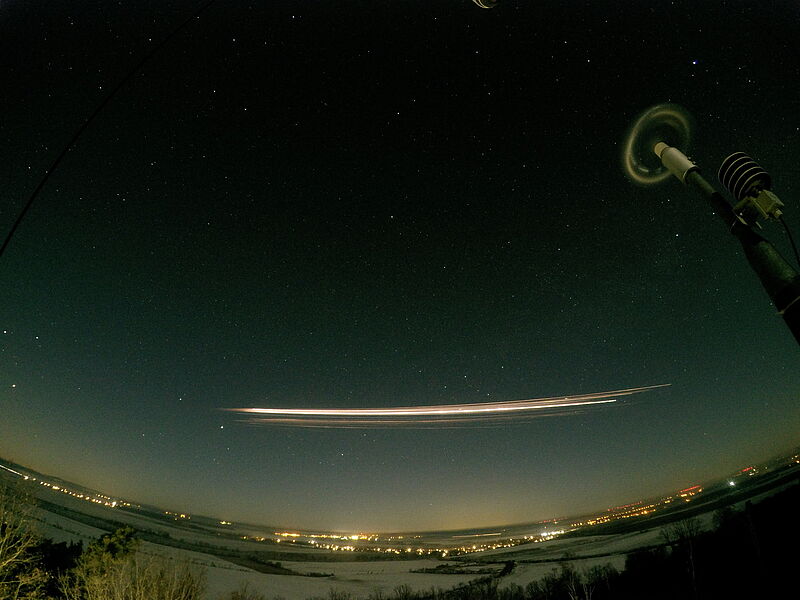
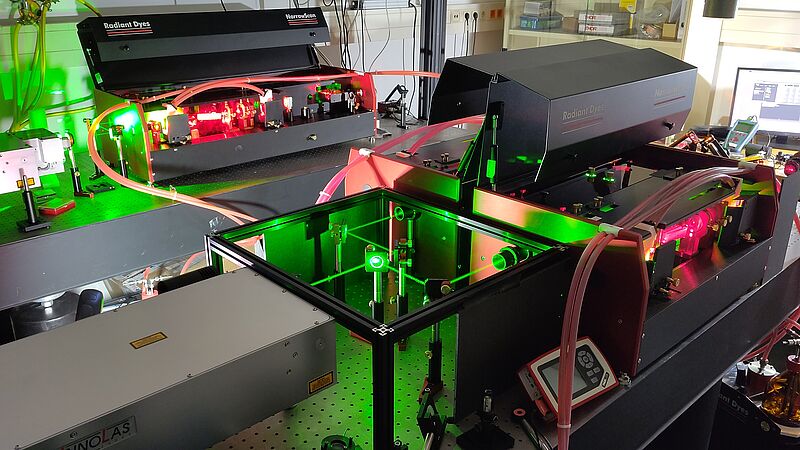
Kühlungsborn, 26.02.2026 – A research team led by Dr Robin Wing and Dr Michael Gerding from the IAP has linked a lithium cloud in the upper atmosphere to the re-entry of a rocket stage for the first time. The findings, published in Communications Earth & Environment, combine high-resolution lidar and radar measurements with atmospheric modelling to demonstrate the formation, dynamics and origin of pollution in the upper atmosphere caused by space debris.
Retired satellites and rocket upper stages usually burn up upon re-entry at altitudes between approximately 60 and 100 kilometres. While earlier studies focused primarily on the risk of debris hitting the ground, the effects of these processes on the mesosphere (approx. 50–85 km altitude) and the lower thermosphere (approx. 85–120 km altitude) have not yet been adequately investigated.
During the night of 19 to 20 February 2025, the research team observed a sudden increase in the concentration of lithium atoms in the lower thermosphere using a powerful resonance lidar system. Lithium is widely used in space travel, but only occurs naturally in trace amounts at these altitudes. The measured concentrations were ten times higher than the natural background level and formed a cloud that extended vertically over several kilometres.
While radar systems provided information on the dynamics in the mesosphere and lower thermosphere, enabling the spread of the lithium cloud to be traced, numerical models were used to reconstruct the movement of the particles backwards. This identified the uncontrolled re-entry of a Falcon 9 rocket upper stage as the source of the high Lithium concentration. Natural causes such as dust input from meteoroids could be largely ruled out.
The study thus provides the first direct measurement of pollution in the upper atmosphere resulting from the re-entry of space debris and, at the same time, the first observational evidence that the ablation of spacecraft during re-entry can be detected using ground-based lidar. Only the combination of lidar, radar and modelling made this clear attribution possible.
Although this is a case study of a single re-entry, given the steep rise in the number of orbital launches in recent years, it can be assumed that the entry of metals and other materials into the atmosphere will continue to increase. The long-term effects this could have on the chemistry, radiation balance and dynamics of the middle atmosphere must be investigated in future through expanded observation programmes and coupled chemistry-climate models.
The work shows that ground-based remote sensing systems, especially when used in combination, are a powerful tool for systematically recording the largely unexplored environmental consequences of increasing space traffic.
Information about the study:
‘Measurement of a lithium plume from the uncontrolled re-entry of a Falcon 9 rocket’
Journal: Communications Earth & Environment
Web link: www.nature.com/articles/s43247-025-03154-8
